

- What is notifiable non-licensed asbestos work (NNLW)?
- Employer checklist: how to identify work that may be NNLW
- Examples of notifiable non-licensed asbestos work
- NNLW do’s and don’ts for employers
- What must employers do before starting NNLW?
- What training is needed for notifiable non-licensed asbestos work?
- Frequently asked questions about NNLW
- Non-licensed asbestos training in Dorset

You have identified asbestos-containing materials in a building, and maintenance or refurbishment is planned. Before you arrange the work, there is an important question to answer: does it need a licensed contractor, or could it be non-licensed work that requires notification?
Notifiable non-licensed asbestos work, usually shortened to NNLW, sits within the non-licensed category. Recognising it early helps you plan the people, paperwork and precautions needed before work starts.
This guide gives employers, contractors and facilities managers a practical checklist, examples and next steps. It explains the framework used in Great Britain; it is an initial guide, not a task-specific assessment or instructions for handling asbestos.
What is notifiable non-licensed asbestos work (NNLW)
Asbestos work falls into three broad categories:
| Category | What it means for planning |
| Licensable work | Work that requires an appropriate HSE asbestos licence. Most higher-risk asbestos work belongs here. |
| Notifiable non-licensed work (NNLW) | Non-licensed work with additional duties covering notification, designated work areas, medical surveillance and health records. |
| Non-notifiable non-licensed work | Work that meets the conditions for exemption from those additional duties. Appropriate controls and worker competence are still essential. |
Check whether the work is licensable first. Only then assess whether non-licensed work needs notification. Submitting an NNLW form cannot make licensable work suitable for a contractor without the required licence.
See HSE’s explanation of licensable work and its introduction to asbestos essentials.
Employer checklist how to identify work that may be NNLW
Use these questions when planning a job. An unanswered question is a reason to obtain more information before committing to the work.
Do you know what material will be disturbed
Relevant asbestos surveys, registers and sampling results have been checked. ☐
The information covers the actual location and materials affected by the job. ☐
Gaps or uncertainty have been referred to someone competent to assess them. ☐
Do not identify asbestos by appearance alone. Where information is missing or unreliable, further survey work or sample analysis may be needed. See HSE’s guidance on identifying asbestos and its condition.
Have you defined the job and assessed the risks
The exact task, scale and expected duration are recorded. ☐
A competent person has assessed likely exposure and who could be affected. ☐
The assessment explains whether the work is licensable and, if not, whether it is NNLW. ☐
A description such as “remove ceiling panels” leaves too much unanswered. The assessment needs to address the material, its condition and the proposed method. HSE’s risk assessment guidance explains what to include.
Have you considered condition and likely fibre release
The assessment considers damage, deterioration and whether the material is friable: easily crumbled or reduced to powder. ☐
It considers whether the proposed work will break down the material holding the fibres together. ☐
These factors matter when assessing notification. Do not assume that two jobs involving the same product have the same classification.
Have you checked the licensing requirements first
The licensing decision considers the material, exposure and applicable duration criteria. ☐
Nobody is relying on “it will only take a few minutes” as the sole justification for non-licensed work. ☐
This checklist supports initial planning. A competent assessment must determine the classification of the actual work.
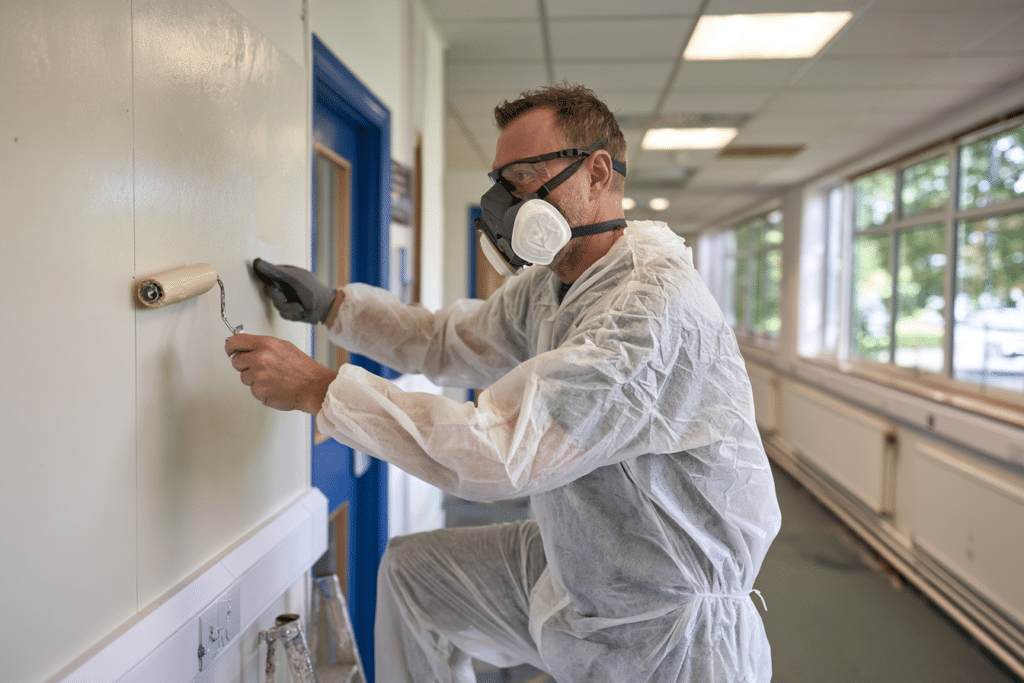
Examples of notifiable non-licensed asbestos work
The following comparisons reflect HSE’s published NNLW examples. They illustrate the distinctions; they do not authorise a particular job.
| Planned work | Possible classification |
| Carefully removing asbestos cement sheets without breaking them | Non-notifiable non-licensed work, subject to assessment. |
| Removing asbestos cement sheets substantially damaged by fire or flooding | NNLW, provided the work is non-licensable. |
| Minor, short-duration removal of asbestos insulating board (AIB) during refurbishment | May be NNLW if the non-licensable conditions are met. |
| Large-scale removal of asbestos-containing textured coatings using steam or gel | NNLW, subject to assessment. |
| Painting AIB in good condition | Non-notifiable non-licensed work, subject to assessment. |
| Removing sprayed asbestos coatings | Licensable work. |
Be particularly careful with AIB
Damaged AIB should never be treated as a straightforward NNLW example. Work on AIB may require a licensed contractor, and a short planned duration alone does not establish that it is non-licensable. Check HSE’s licensing guidance before choosing the route.
For an employer, the useful question is: what evidence supports the classification of this job? Ask for the reasoning in the assessment, rather than accepting a product name or a verbal assurance.
If your team needs training for planned non-licensed tasks, explore Ouch’s Non-Licensed Asbestos Work (CAT B) course.

NNLW actions and common mistakes for employers
| Do | Don’t |
| Check that the asbestos information matches the work area. | Assume an old survey answers every question about a new project. |
| Ask a competent assessor to explain the classification. | Choose NNLW simply because it seems easier to arrange. |
| Consider the condition of the material and how the work will affect it. | Assume every asbestos cement job has identical notification requirements. |
| Review the assessment when the job or conditions change. | Continue under the original plan when its assumptions no longer apply. |
| Match training, instruction and supervision to the actual tasks. | Treat an asbestos awareness certificate as sufficient preparation for planned asbestos work. |
Build these checks into the job briefing. A clear decision before people arrive on site gives the supervisor something useful to work from and helps avoid last-minute uncertainty.
What must employers do before starting NNLW
After you assess the work as NNLW, the following arrangements need attention.
Notify the relevant enforcing authority
Use the official ASB NNLW1 online notification form. The appropriate authority depends on the premises and activity; it is not always HSE.
Notification must happen before work starts. There is no minimum notice period for NNLW and no requirement to wait for permission after submission. Keep the notification copy with the job records. Notify the relevant authority without delay of any material change affecting the notified particulars. Notification does not replace the assessment or other precautions. See HSE’s L143 publication, regulation 9 guidance.
Prepare the assessment, plan and controls
Record how the work will be managed, including exposure controls, suitable protective equipment, decontamination, waste arrangements and emergency procedures. Account for other site hazards too, such as work at height.
Brief the people doing the work and make sure the arrangements are in place before starting. HSE’s EM0 guidance on risk assessments and plans of work provides a useful planning reference.
Designate the work area
Mark the NNLW area with suitable warning notices and restrict access to those carrying out the work. Food and drink must not be consumed there. These are additional requirements identified in HSE’s NNLW guidance.
Arrange medical surveillance and health records
Before beginning NNLW, workers must have had the required medical examination within the preceding three years. Examinations must then be repeated at least every three years while exposure continues, or sooner if the doctor requires. Existing valid surveillance for licensed asbestos work can meet this requirement. Check the arrangements with the medical practitioner; see HSE’s medical surveillance guidance.
The employer must retain the medical examination certificate, or a copy, for at least four years from issue. Keep individual health records covering the work, its duration, estimated exposure and medical examination dates. The statutory retention minimum is 40 years from the last entry. The guidance accompanying HSE’s ACOP recommends keeping records until age 80 if that is longer. These employer records are separate from the doctor’s confidential clinical records. See L143, regulation 22 and associated guidance.

What training is needed for notifiable non-licensed asbestos work
Asbestos awareness helps workers recognise potential asbestos risks and avoid disturbing materials. It does not prepare them to carry out planned work on asbestos-containing materials.
Workers undertaking non-licensed work, including NNLW, need further information, instruction and training appropriate to their tasks. This includes understanding assessments, control measures, protective equipment, waste arrangements and emergency procedures.
Course attendance alone does not establish competence. Employers must consider practical ability, experience, instruction and supervision. See HSE’s asbestos training guidance.
Ouch’s Non-Licensed Asbestos Work (CAT B) training covers risk assessment, plans of work, protective equipment, decontamination, waste and emergency procedures. The course page lists a valid Asbestos Awareness certificate as a prerequisite.
If employees need awareness training first, view our Asbestos Awareness (CAT A) course. Discuss the proposed tasks with Ouch and confirm that the selected course covers the particular non-licensed work and any NNLW duties relevant to your team. A CAT B course title alone does not establish that every NNLW task is covered.
Frequently asked questions about NNLW
Is all non-licensed asbestos work notifiable
No. Some non-licensed work qualifies for exemption from the additional notification, designated-area, medical surveillance and health-record duties. The decision depends on the assessed work and applicable conditions. Non-notifiable work still needs appropriate precautions.
Does NNLW need to be notified to HSE
It must be notified to the relevant enforcing authority before starting. Use the official online form, which includes selection of the responsible authority.
Can asbestos awareness training cover NNLW
Awareness training alone is insufficient. Planned asbestos work requires further task-appropriate information, instruction and training, supported by the arrangements needed for workers to carry it out competently.
Can you carry out NNLW without an asbestos licence
NNLW is non-licensable work. A licence is not required for correctly classified NNLW, but employers must meet the relevant duties. If the work is licensable, an NNLW notification or CAT B certificate cannot replace the required licence.
Prepare your team with non-licensed asbestos training
Planning training before a job is scheduled gives you time to check prerequisites, identify gaps and organise attendance around your operations.
Ouch Learning & Development offers Non-Licensed Asbestos Work (CAT B) training in Wimborne for businesses across Dorset and Greater Manchester, including Bournemouth, Poole and Christchurch, Stockport and Manchester. Speak to the team about the work your employees are expected to undertake and the training they may need.
View upcoming non-licensed asbestos training dates or contact Ouch to discuss your requirements.