

Table of Contents:
What affects fire marshal numbers

Quick answer: There is no fixed legal number of fire marshals or fire wardens that every UK workplace must have. You need enough trained people to make your fire safety and evacuation arrangements work effectively, based on your fire risk assessment.
The amount of people who need fire marshal training will depend on a few factors, such as:
- The size of your workplace
- How many people are on site
- The level of fire risk
- The number of floors, departments or work areas
- Shift patterns and opening hours
- Holidays, sickness and other absences
- Anyone who may need assistance to evacuate
For example, appointing one fire marshal may not provide enough practical cover if that person is on holiday, working from home, away from the premises or unavailable when an emergency occurs.
For many employers, the better question is not simply “How many fire marshals do I need?” It is “Do we have enough trained fire marshals to provide reliable cover whenever our workplace is occupied?” Your fire risk assessment should help you answer that question.
If you are still clarifying responsibilities, it may also help to read our guides on do fire wardens need training and whether Fire Marshal training is a legal requirement.

Is there a set number of fire marshals per employee?
There is no universal fire marshal-to-employee ratio that applies to every UK workplace.
Using headcount alone can be misleading. Two businesses with the same number of employees may have very different fire safety needs. A small, single-floor office with simple escape routes is very different from a warehouse, workshop, school, care setting, construction site or multi-floor workplace operating several shifts.
Instead, your fire risk assessment should consider:
- The premises
- The people at risk
- The fire hazards present
- The emergency arrangements
- The working patterns across the day or week
- The people who may need extra help in an emergency
GOV.UK says the responsible person must carry out and regularly review a fire risk assessment of the premises, then record findings, prepare an emergency plan and provide training.
That means your fire marshal cover should be based on your real working environment, not a generic number copied from another business.

What affects how many fire marshals you need?
Your fire marshal numbers should reflect how your workplace actually operates. Start with these main factors.
Workplace size and layout
A small office will usually be easier to cover than a large site with several floors, separate buildings, workshops, stock areas or remote working zones.
Think about whether one person could realistically support the evacuation arrangements for the area they are responsible for. If your workplace is split across different departments, floors or units, you may need trained cover in each main area.
Number of people on site
Your fire marshal cover should reflect the number of people who may be on site, including employees, visitors, contractors, customers, learners or service users.
A workplace with regular visitors or members of the public may need more support during an evacuation than a small office where everyone knows the building well.
Fire risk level
Higher-risk environments may need more fire marshal cover. Examples include workplaces with hot works, cooking, flammable substances, electrical equipment, manufacturing processes, workshops, plant rooms, storage areas or complex housekeeping risks.
The HSE says a workplace fire risk assessment should identify what could cause a fire to start, such as sources of ignition and substances that burn, as well as the people who may be at risk. A low-risk office and a busy workshop should not automatically have the same fire marshal arrangement.
In workplaces with higher fire risks, it is also worth making sure staff understand the limits of their role during an emergency. For example, our guide on using a fire extinguisher if you are not trained explains why fire safety procedures and training matter before an incident occurs.
Shift patterns and absence cover
A common mistake is appointing enough fire marshals for the busiest day shift, but forgetting evenings, weekends, early starts, late finishes, lone working or overtime.
If your business runs shifts, you need suitable cover when people are actually working. A fire marshal who only works Monday to Friday cannot provide cover for a night shift, Saturday team or early cleaning crew.
You should also plan for:
- Annual leave
- Sickness
- Training days
- Working from home
- Staff turnover
- People being called away from site
For many businesses, training deputies is the simplest way to avoid gaps.
People who may need help evacuating
Some people may need extra support in an emergency. This could include disabled people, people with temporary mobility issues, visitors unfamiliar with the building, young people, older people, vulnerable service users or anyone working alone.
Government guidance says fire safety arrangements can include a suitable emergency evacuation plan, personal emergency evacuation plans for people who may need assistance, and the appointment of employees with special responsibilities in the event of fire, such as fire wardens.
Fire marshal cover should be planned around those needs, not just employee numbers. Clear identification can also help during drills and evacuations, so you may find our guide on when a Fire Marshal should wear their vest useful.

How to work out your fire marshal cover
A simple way to review your cover is to consider the details of how your workplace is occupied alongside this checklist:
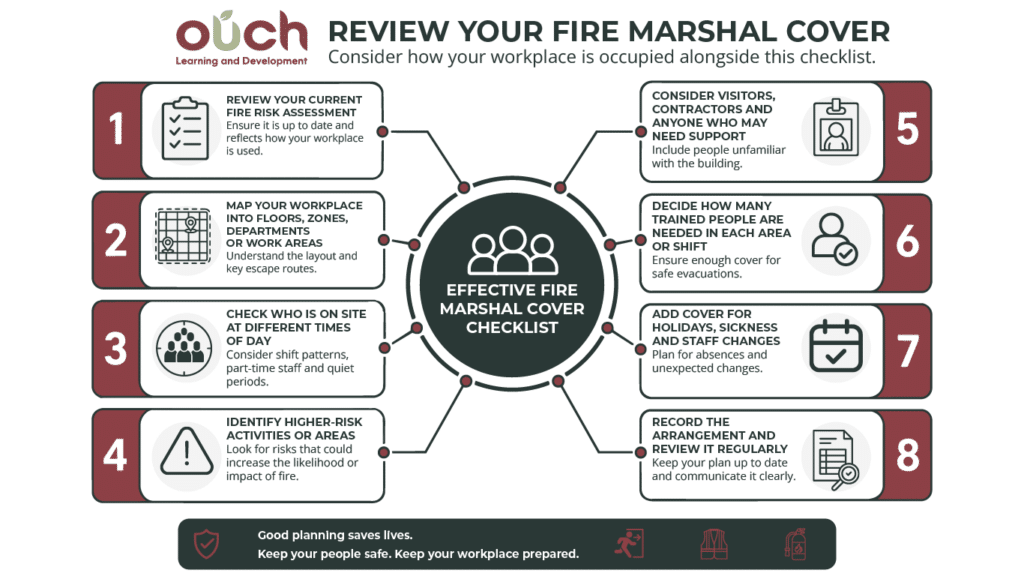
- Review your current fire risk assessment.
- Map your workplace into floors, zones, departments or work areas.
- Check who is on site at different times of day.
- Identify higher-risk activities or areas.
- Consider visitors, contractors and anyone who may need support.
- Decide how many trained people are needed in each area or shift.
- Add cover for holidays, sickness and staff changes.
- Record the arrangement and review it regularly.
This helps avoid the “one named person” problem, where a business technically has a fire marshal but no practical cover when that person is off site.
In short, you need enough trained fire marshals to make your emergency plan work in real life. Your fire risk assessment should guide the decision, and your cover should reflect your building, risks, occupancy, shifts and evacuation needs.
Need to train additional fire marshals?
If your review identifies gaps in cover, Ouch provides practical Fire Marshal training for Dorset businesses, including teams in Bournemouth, Poole, Christchurch, Wimborne and the surrounding area.
Training deputies alongside your main fire marshals can help maintain cover during holidays, sickness, shift changes and busy operating periods.

Fire Marshal training for Dorset workplaces
Employees identified in your emergency plan as having a supervisory role in a fire, including fire marshals or fire wardens, should receive additional training for those responsibilities.
GOV.UK’s offices and shops guidance says staff identified in the emergency plan with a supervisory role if there is a fire, including fire marshals or wardens, should be given details of the fire risk assessment and receive additional training.
For SMEs in Bournemouth, Poole, Christchurch, Wimborne and across Dorset, appointing enough fire marshals is only part of the challenge. You also need to train them without leaving shifts, departments or sites short.
A low-disruption approach could include:
- Training deputies as well as lead fire marshals
- Staggering staff across different course dates
- Prioritising supervisors, team leaders or people normally present on site
- Making sure each shift has trained cover
- Keeping a simple training record with certificate dates
- Reviewing cover before busy seasons, new contracts or layout changes
Ouch’s Fire Marshal course is a 1-day course, certificated by Ouch Learning & Development, with face-to-face and live online delivery formats available. The course is designed to help learners understand fire safety procedures and policies, assist the Fire Safety Manager, understand the principles of fire safety management at work and understand the role of the nominated Fire Marshal.
Ouch’s wider approach is built around low-disruption safety training for busy Dorset teams, with predictable schedules, local delivery and support for businesses where releasing staff is difficult.
Frequently asked questions
How many fire marshals should there be in your workplace?
There is no fixed number for every workplace. Your fire risk assessment should determine how many fire marshals you need based on your workplace size, layout, occupancy, shift patterns, fire risks and evacuation arrangements.
Is there a legal number of fire marshals required in the UK?
There is no universal legal ratio for fire marshals in the UK. The responsible person must have suitable fire safety arrangements based on the fire risk assessment, including emergency planning and staff training where required.
How many fire wardens do I need?
You need enough fire wardens or fire marshals to support your emergency arrangements whenever your workplace is occupied. This should include cover for different areas, shifts, holidays, sickness and people who may need help evacuating.
How many fire marshals do you need per employee?
There is no fixed fire marshal-to-employee ratio for every workplace. Employee numbers matter, but so do layout, fire risk, occupancy, shifts, visitor numbers and evacuation needs.
Is one fire marshal enough for a small business?
One fire marshal may not be enough if that person is absent, working from home, on holiday or unavailable during an emergency. Many small businesses choose to train at least one deputy so there is more reliable cover.
Where can I book Fire Marshal training in Dorset?
Ouch Learning & Development provides practical Fire Safety training for Dorset workplaces, including teams in Bournemouth, Poole, Christchurch, Wimborne and the surrounding area.