
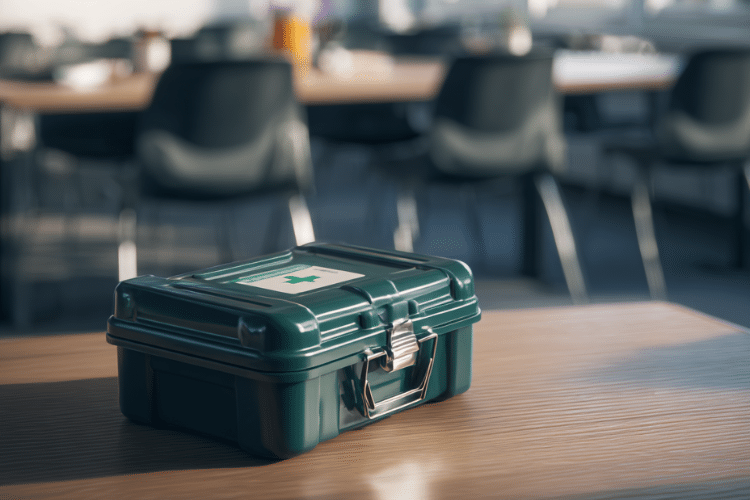
Every UK workplace must have appropriate emergency first aid provision. However, what should be in a first aid kit at work depends on your environment, number of employees, and the risks involved.
This guide explains:
- What should be in a first aid kit at work based on UK guidance
- What should be in a first aid box at work for different types of businesses
- How to adapt your kit based on risk assessment
- What training your staff need to stay compliant
What Should Be in a First Aid Kit at Work?
A basic workplace first aid kit should include the following items:
- Sterile plasters in assorted sizes
- Sterile wound dressings (medium and large)
- Triangular bandages
- Safety pins
- Sterile eye pads
- Disposable gloves
- Antiseptic wipes
- Adhesive tape
- Scissors
- A first aid guidance leaflet
This is the minimum expected for most low-risk workplaces and is designed to deal with common injuries such as cuts, minor burns, and eye injuries.
HSE Guidance for Workplace First Aid Kits
The Health and Safety Executive does not provide a fixed list of required items. Instead:
- First aid kits must be based on a workplace risk assessment
- There is no universal checklist that applies to every business
- Many employers choose kits that meet BS 8599-1 British Standard
In practice, this means your first aid kit should reflect the actual risks in your workplace rather than relying on a generic list.
What Should Be in a First Aid Box at Work Based on Risk?
Different workplaces require different levels of first aid provision.
Offices and Low-Risk Environments
Most offices in areas such as Bournemouth, Poole, and Wimborne will require:
- The standard checklist items listed above
- At least one appointed person or trained first aider
- A clearly accessible and well-maintained kit
Warehouses, Workshops and Higher-Risk Environments
If your workplace involves machinery, tools, or manual handling, you may need additional items such as:
- Burn dressings
- Eye wash solution
- Foil blankets for treating shock
- Additional bandages and dressings
Hospitality and Food Businesses
For kitchens and food environments, consider including:
- Blue detectable plasters
- Burn gel or specialist burn dressings
- Extra disposable gloves for hygiene control
Many small businesses make the mistake of using a standard kit without adapting it to their specific risks.
What Should Not Be in a Workplace First Aid Kit?
To stay compliant and safe:
- Do not include general medication such as paracetamol
- Do not keep expired or damaged items
- Do not include non-sterile materials
First aid kits should be checked regularly to ensure they are complete and within expiry dates.
Do You Need First Aid Training for Staff?
Providing a first aid kit is only part of your responsibility as an employer.
You must also ensure:
- There are enough trained first aiders for your workplace
- Staff can respond effectively in an emergency
- Your level of provision matches your risk assessment
For many small and medium-sized businesses, this typically means:
- Emergency First Aid at Work (EFAW) for low-risk environments
- First Aid at Work (FAW) for higher-risk workplaces
Book First Aid Training in Dorset
If you are unsure whether your workplace meets current requirements, training is often the simplest way to ensure compliance.
Ouch Learning and Development delivers accredited first aid training across Dorset, including:
- First Aid Courses in Bournemouth
- Poole
- Christchurch
- Wimborne
Courses are designed to be practical and easy to attend, with convenient locations, accessible parking, and regular course dates suitable for busy businesses.
Available courses include:
- Emergency First Aid at Work
- First Aid at Work
- First Aid at Work Requalification
Booking training ensures your staff are prepared to respond confidently and helps you meet your legal responsibilities.
Workplace First Aid Checklist
Before you finish reviewing your provision, consider the following:
- Do you have a fully stocked first aid kit?
- Is it appropriate for your specific workplace risks?
- Are all items in date and ready to use?
- Do you have trained first aiders available when needed?
If any of these areas need attention, it may be time to review your first aid arrangements.