

If you’re working through IOSH Managing Safely, you’ll come across the term hazardous event. It’s a key part of the risk assessment process, but many learners ask the same question: what does it actually mean, and why is it important? Let’s break it down in clear, practical terms.
What is meant by a hazardous event in IOSH?
In IOSH terminology, a hazardous event is an incident or situation where harm could occur. It refers to the point at which a hazard has the potential to cause injury, ill health, damage, or loss.
A simple way to think about it is:
- A hazard is something with the potential to cause harm.
- A hazardous event is when that harm could realistically happen.
For example, a wet floor is a hazard. Someone slipping on it is the hazardous event.
Why hazardous events matter in IOSH risk assessments
Identifying hazardous events is essential because it helps you understand how people might be harmed. IOSH uses this approach to make risk assessments more practical and focused on real-world situations.
By recognising hazardous events, organisations can:
- Put effective control measures in place
- Reduce the likelihood of incidents
- Prevent injuries and near misses
- Strengthen compliance with UK health and safety legislation
It’s about looking beyond the hazard itself and understanding how it interacts with people, equipment, and the working environment.
IOSH hazard categories
When assessing risks, IOSH encourages learners to consider a wide range of hazard categories. These often include:
- Physical hazards, such as slips, trips, falls, noise, or machinery
- Chemical hazards, including fumes, dusts, or cleaning agents
- Biological hazards, such as bacteria, viruses, or bodily fluids
- Ergonomic hazards, linked to posture, repetitive tasks, or manual handling
- Psychosocial hazards, including stress, workload, or conflict
- Environmental hazards, such as poor lighting or extreme temperatures
Understanding these categories helps managers identify hazardous events more accurately and put the right controls in place.
Examples of hazardous events in the workplace
To make the concept clearer, here are a few everyday examples:
- A worker climbing a ladder that hasn’t been secured
- A delivery driver lifting a heavy box without proper technique
- A chemical container leaking in a storeroom
- An employee rushing across a cluttered walkway
- A team member working alone without effective communication systems
Each example shows a moment where harm could occur, which is exactly what IOSH wants managers to recognise.
How identifying hazardous events helps prevent accidents
If you can spot the point where harm could happen, you can intervene before it does. That’s why IOSH places so much emphasis on understanding hazardous events. It helps organisations to:
- Strengthen day-to-day safety practices
- Reduce incident rates
- Improve employee confidence
- Build a proactive safety culture
It’s a practical skill that makes a real difference in the workplace.
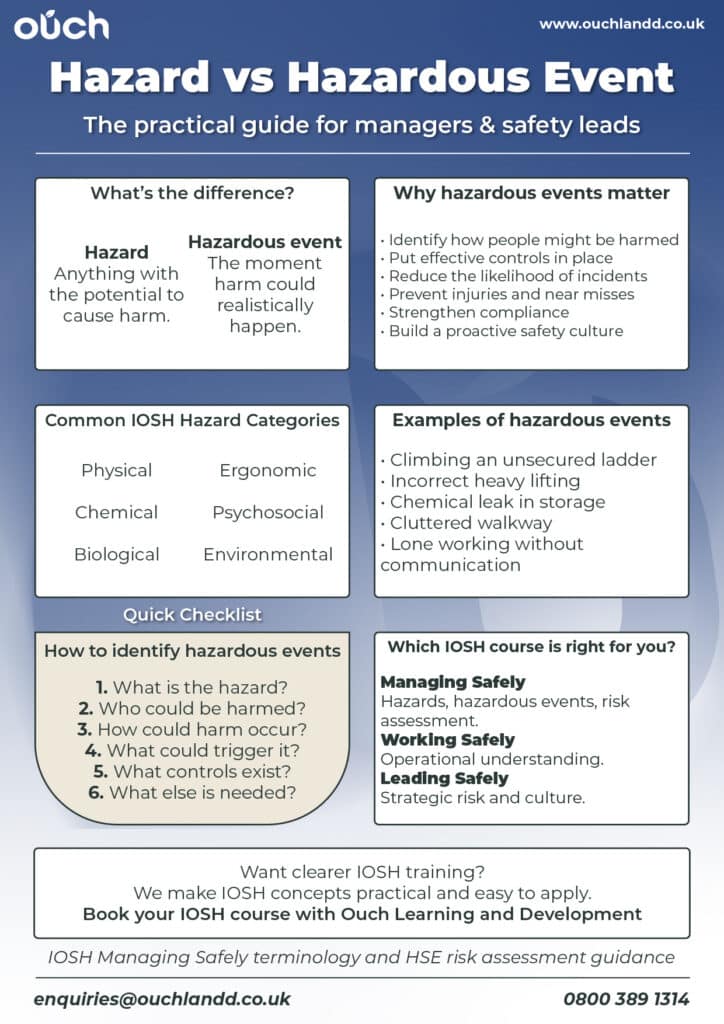
Here’s a practical guide for managers and safety leads:
Designed for managers and safety leads, this poster gives a clear, IOSH‑aligned explanation of what each term means, why the distinction matters, and how it affects real‑world safety decisions.
Why choose Ouch for IOSH training?
At Ouch Learning and Development, we make IOSH concepts clear, relatable, and easy to apply. Our trainers:
- Use real-world examples to explain hazardous events
- Guide learners through practical risk assessment exercises
- Support organisations in building confident, competent managers
If you want to strengthen your team’s understanding of risk and improve workplace safety, we’re here to help you choose the right IOSH course.
References
For further reading and official guidance: