
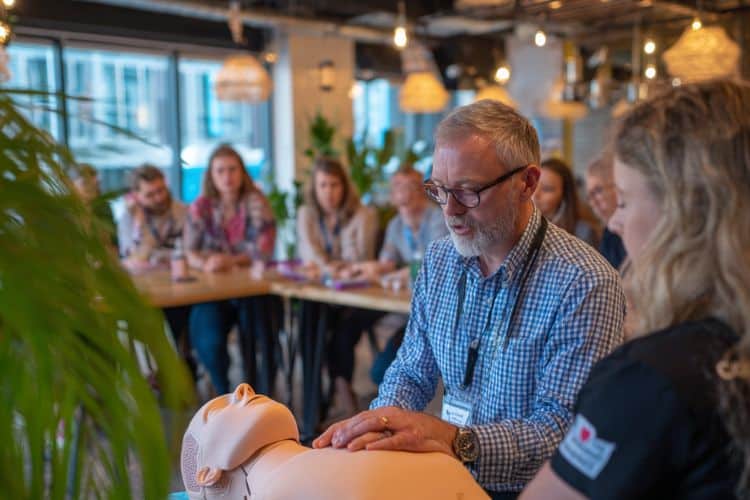
It is a question many people think about before attending training, even if they do not always ask it out loud.
Can you actually fail a First Aid at Work course?
The short answer is yes, it is possible. But in practice, most people pass because the course is designed to support you every step of the way.
Do people fail First Aid at Work courses?
First Aid at Work courses are assessed, which means learners must demonstrate that they can carry out key skills safely and correctly.
This includes both:
- Practical skills
- Basic knowledge and understanding
If someone is unable to demonstrate these to the required standard, they may not pass.
However, this is not an exam in the traditional sense. The focus is not on catching people out. It is on making sure that anyone who completes the course is genuinely capable of helping in an emergency.
What do you need to do to pass?
To pass a First Aid at Work or Emergency First Aid at Work course, learners need to show that they can:
- Assess an emergency situation
- Respond calmly and safely
- Perform key techniques such as CPR
- Follow correct procedures for common incidents
It is about practical ability, not memorising large amounts of information.
In other words, can you do the right thing when it matters?
How are First Aid courses assessed?
Assessment is continuous throughout the course.
Rather than a single final test, your trainer will observe how you:
- Take part in practical exercises
- Respond to scenarios
- Apply what you have learned
This approach helps reduce pressure. It also gives you time to build confidence as you go.
If something is not quite right, you will usually have the opportunity to try again with guidance.
Why it is possible to fail
While most learners pass, there are situations where someone may not meet the required standard.
This could include:
- Not being able to perform CPR correctly
- Struggling to follow key safety steps
- Not engaging with the practical elements
- Missing significant parts of the course
The reason for this is simple. In a real emergency, there is no room for guesswork. The training needs to ensure that anyone certified can act safely and effectively.
How courses are designed to help you pass
Although it is possible to fail, First Aid courses are structured to support you throughout.
Trainers are there to guide, not judge.
During the course, you will:
- Practise each skill step by step
- Receive clear demonstrations
- Get feedback and support
- Have time to build confidence
If you are unsure about something, you are encouraged to ask. That is how people improve.
Most learners find that their confidence grows quickly once they start practising.
What if you struggle during the course?
It is completely normal to feel unsure at the beginning, especially if you have never done first aid training before.
Good training providers recognise this.
If you struggle with a particular skill:
- The trainer will work with you
- You will be shown the technique again
- You will have the chance to practise
The goal is not to rush through the content. It is to make sure you are comfortable with what you are doing.
What happens if you do not pass?
If someone does not meet the required standard, the next step depends on the situation.
In most cases:
- Additional support or practice may be offered
- You may be invited to retake part or all of the course
This ensures that when you do receive certification, it reflects real capability.
Why the standard matters
It can be reassuring to know that not everyone automatically passes.
That is what gives the qualification value.
In a real workplace emergency:
- People rely on the trained first aider
- Decisions need to be made quickly
- Actions need to be correct
The assessment process ensures that the person stepping forward is ready.
A supportive learning environment
For most people, the experience is far more positive than they expect.
First Aid training is:
- Practical
- Interactive
- Supportive
It is not about exams or pressure. It is about building confidence in a safe environment.
By the end of the course, most learners are surprised at how much they can do.
A practical approach for SMEs
For many SMEs, there can be concern about sending staff on training.
Will they pass? Will it be too difficult?
In reality, First Aid at Work courses are designed to be accessible.
At Ouch Learning and Development, we focus on:
- Clear, step-by-step instruction
- Real workplace scenarios
- Small group sizes with a maximum 12:1 ratio
The aim is to make sure your team leaves confident, not overwhelmed.
Training is completed efficiently, without unnecessary disruption to your business.
Final thoughts
Yes, it is possible to fail a First Aid at Work course.
But the course is designed to help you succeed.
With the right support, practice, and guidance, most learners pass and leave with the confidence to act when it matters.
That confidence is what makes the training valuable.
When something happens, your team will not be guessing. They will be ready to respond.
Further reading and official guidance (UK)
For more information on First Aid at Work requirements and standards in the UK, you can refer to the following trusted sources: