Fire wardens play a central role in workplace fire safety. Under UK law, they must be properly trained to carry out their duties effectively and confidently, so yes, fire wardens do need specialist fire warden training.
If someone in your organisation is expected to support evacuations, check escape routes, or assist with fire prevention, training is not optional. It is a legal expectation.
Below, we explain what the law requires, how often training should be refreshed for day and night staff, and what competent fire marshal training should include.
What does the law say about fire warden training?
The Regulatory Reform (Fire Safety) Order 2005 places a duty on the responsible person to provide adequate fire safety training to employees. This training must be:
- Provided at the time of induction
- Repeated periodically
- Adapted to reflect any new or increased risks
Where employees are appointed as fire wardens or fire marshals, they must receive training that reflects their additional responsibilities.
In practical terms, this means structured, role-specific training. A short briefing or toolbox talk is not enough for someone expected to manage aspects of an evacuation or support fire safety procedures.
Why fire wardens need practical, hands-on skills
In an emergency, people look for clear direction. A trained fire warden understands both the procedure and the reasoning behind it.
Effective fire wardens can:
- Identify common fire hazards and ignition sources
- Support fire prevention measures
- Check escape routes and report defects
- Assist with evacuations and sweep designated areas
- Communicate clearly with staff, visitors and emergency services
- Support the responsible person in maintaining inspection records
Without proper training, these tasks become reactive rather than controlled. Training replaces uncertainty with competence.
At Ouch Learning and Development, our Fire Marshal course is designed to create confident individuals who can take charge in an emergency. We cover legislation, fire behaviour, prevention measures, extinguisher awareness, emergency procedures, hot works permits, inspection records and hazard identification.
The focus is always practical application, not theory alone.
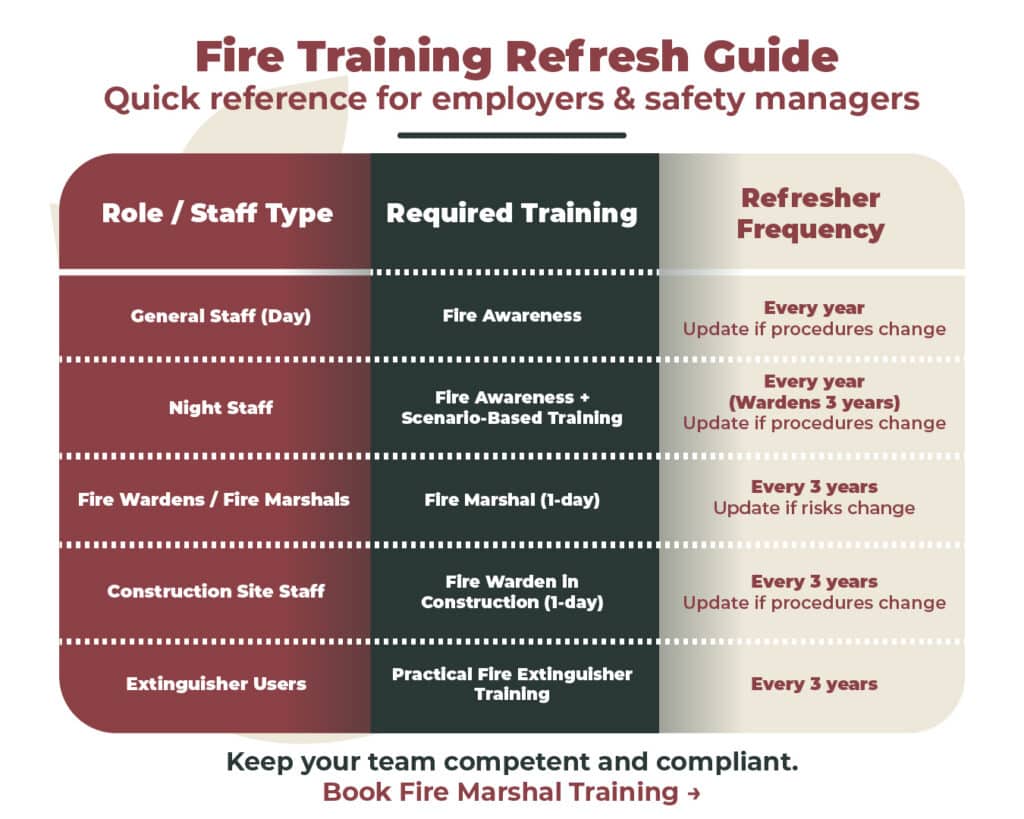
How often do day staff require fire training?
All employees must receive fire safety training as part of induction under the Regulatory Reform (Fire Safety) Order 2005.
For day staff, good practice is:
- Fire awareness training at induction
- Refresher training annually
- Updated training whenever procedures, layouts or risks change
Where day staff are appointed as fire wardens or fire marshals, refresher training is typically recommended every three years, in line with common industry practice and competence expectations.
Regular refreshers ensure staff remain familiar with evacuation routes, assembly points and their specific responsibilities.
How often do night staff require fire training?
Night staff often operate with fewer people on site. In some settings, they may be the only trained person present. This increases responsibility.
Night staff should receive:
- Induction fire safety training
- Annual refresher training
- Additional scenario-based input tailored to lone working or reduced staffing levels
If a member of the night team is appointed as a fire warden or marshal, the same three-year refresher cycle applies, with earlier updates if risks change.
Training should reflect the realities of night operations, including temporary accommodation units, plant areas or restricted access zones where relevant.
How often should fire marshal training be refreshed?
Fire marshal training is generally refreshed every three years. However, earlier retraining is appropriate where there are:
- Significant building alterations
- Changes in occupancy levels
- New equipment or processes
- Updated emergency procedures
- A prolonged absence from the role
Competence must be maintained. The law requires training to be appropriate and up to date, not simply completed once and forgotten.
What good fire warden training should include
High-quality fire warden training should cover:
- Fire legislation and legal responsibilities
- The causes of fire and ignition sources
- Fire prevention measures
- Emergency procedures and evacuation techniques
- Fire extinguisher selection and safe use awareness
- Inspection records and hot works permits where relevant
- Hazard identification and risk control
At Ouch Learning and Development, our Fire Marshal and Fire Warden in Construction courses are delivered face-to-face or live online, with a maximum 12:1 learner-to-trainer ratio.
We focus on clarity, practical examples and real workplace scenarios. The aim is simple. When an alarm sounds, your team knows exactly what to do.
Why choose Ouch for fire warden training?
Fire safety is a legal responsibility, but it is also about protecting people and livelihoods.
We provide:
- One-day Fire Marshal training
- Specialist Fire Warden in Construction training
- Half-day Fire Awareness courses for all staff
- Practical Fire Extinguisher training
All courses are certificated by Ouch Learning and Development, valid for three years, and aligned with current UK fire legislation.
If you are reviewing your fire safety arrangements or unsure whether your wardens are up to date, we are here to guide you through the next steps.
Fire training refresh guide
To support this blog, here is a downloadable comparison chart so you know when fire training needs to be refreshed: